Publication Rules and Author Guidelines
Al-Fateh Journal for Educational and Psychological Research accepts original research manuscripts written in Arabic or English in the fields of education, psychology, and related disciplines. Submission of a manuscript to the journal constitutes confirmation that all authors have read and agreed to comply with the journal’s publication rules and policies concerning peer review, publication ethics, plagiarism, the use of artificial intelligence, copyright, licensing, and publication fees.
First: Scope and Originality of Manuscripts
- The manuscript must fall within the journal’s stated aims and scope and provide a clear scholarly contribution to education, psychology, or a related discipline.
- The manuscript must be original and must not have been previously published in an identical or substantially overlapping form or be under simultaneous consideration by another journal or publishing body. Any related thesis, dissertation, conference paper, repository version, or previous work must be disclosed.
- The journal accepts manuscripts derived from master’s theses and doctoral dissertations, provided that they are presented as independent and complete research articles rather than summaries of the original theses or dissertations. Authors must clearly disclose the source from which the manuscript was derived.
- A manuscript whose abstract or preliminary findings have previously been presented at a scientific conference may be submitted, provided that it has not already been published as a full paper that is identical to or substantially overlaps with the manuscript submitted to the journal.
- When the submitted manuscript is an expanded version of a published conference paper, it must contain a substantial scholarly contribution. The previous publication must be disclosed and cited, and the authors must explain the additions and differences introduced in the submitted version.
- Every person listed as an author must have made a genuine scholarly contribution to the manuscript and must approve the submitted version, the order of authorship, and submission to the journal.
- No author may be added or removed, and the order of authors may not be changed after submission, unless a justified written request is submitted with the written consent of all authors and is approved by the Editorial Board.
- The corresponding author is responsible for communicating with the journal, verifying the accuracy of all author information, and obtaining the authors’ approval of all revisions and the final version.
Second: Manuscript Submission and Correspondence
- Manuscripts must be submitted electronically through the journal’s official online submission system.
- The corresponding author must create an account in the journal’s system, complete all required information, and upload the manuscript and accompanying documents in accordance with the electronic submission procedure.
- The manuscript must be submitted in Microsoft Word format and prepared using the journal’s official template available on its website.
- All official correspondence concerning submission, peer review, revision, acceptance, and publication shall be conducted through the journal’s online system or its official email address:
- Messages sent through WhatsApp, Telegram, or social media platforms are not considered official manuscript submissions and do not replace the journal’s online submission system or official email.
- The corresponding author must regularly monitor the submission account and email address and respond to the journal’s communications within the period specified at each stage.
Third: Manuscript Information and Required Components
The manuscript must include the following information and components:
- A clear and accurate title in both Arabic and English.
- The names of all authors as they should appear in the published article, together with each author’s full institutional affiliation, including department, college or institution, university, city, and country.
- The email address of each author, with the corresponding author clearly identified.
- The ORCID identifier of each author.
- An Arabic abstract and an English abstract, each containing between 200 and 250 words and briefly presenting the purpose, methodology, principal findings, and conclusions of the study. Abstracts should not include references or undefined abbreviations.
- At least five keywords must be provided in each language, Arabic and English. The keywords must accurately represent the subject of the manuscript and should not merely repeat words used in its title.
- A logically organized scientific text appropriate to the nature and methodology of the study. Depending on the type of research, the manuscript may include an introduction, research problem, significance, objectives, questions or hypotheses, theoretical framework or previous studies where relevant, methodology, population and sample, instruments and procedures, statistical analysis, results, discussion, conclusions, recommendations, and references.
- All abbreviations and unfamiliar terms must be defined when first used.
- The following declarations must be included at the end of the manuscript whenever applicable:
- Research ethics committee approval.
- Informed consent of participants.
- Declaration of competing interests.
- Funding or financial support.
- Author contributions.
- Data availability.
- Acknowledgment of individuals or organizations whose assistance does not meet the criteria for authorship.
- Disclosure of the use of generative artificial intelligence tools.
Fourth: Manuscript Preparation and Formatting
- The manuscript must be prepared using the journal’s official template and must comply with its formatting requirements, including font type and size, margins, line spacing, main and subheadings, tables, figures, and references.
- The manuscript must be written in clear and accurate academic language and must be free from grammatical, spelling, and linguistic errors, whether submitted in Arabic or English.
- Authors are responsible for the linguistic quality of their manuscripts. The journal may require professional language editing before acceptance or publication.
- The base publication fee covers a manuscript of up to 20 pages when prepared according to the journal’s official template. An additional fee of IQD 5,000 applies to each page beyond page 20 in accordance with the journal’s approved fee policy.
- Units of measurement, symbols, terminology, and abbreviations must be used consistently throughout the manuscript.
- Pages, headings, tables, figures, and appendices must be numbered consecutively and organized clearly.
- No substantial changes may be made to the subject, data, or findings of an accepted manuscript without the approval of the Editorial Board.
Fifth: Citations and References
- The journal follows the Publication Manual of the American Psychological Association, Seventh Edition (APA 7th Edition) for in-text citations and reference lists.
- In-text citations must follow the author–date system. Page numbers must be included for direct quotations, as illustrated below:
(قطامي، 2000، ص. 35)
(Mark, 2000, p. 35)
- Every source cited in the manuscript must appear in the reference list, and every item in the reference list must be cited in the manuscript.
- Authors are responsible for the accuracy and completeness of all reference information, including author names, year of publication, title, journal or publisher, volume, issue, and page range.
- A source’s DOI must be included whenever available and presented as a valid electronic link.
- References must be arranged and formatted consistently in accordance with APA 7
- Arabic-language references must be presented in their original form and accompanied by transliterated or translated bibliographic information in English, in accordance with the journal’s official template.
- Authors should rely, whenever possible, on original, recent, reliable, and directly relevant scholarly sources and avoid citing sources that cannot be verified.
- Fabricated, nonexistent, or unverified references must not be included. Authors must independently verify the existence and accuracy of every reference, including references generated or formatted using automated tools.
Sixth: Tables, Figures, Images, and Appendices
- Tables, figures, and images must be numbered consecutively according to the order in which they are cited in the manuscript.
- Each table and figure must have a clear and concise title. Explanatory notes and source information must be provided where necessary.
- Every table, figure, image, and appendix must be cited and discussed in the manuscript.
- Tables must be submitted in an editable format and should not be inserted as screenshots unless absolutely necessary.
- Figures, diagrams, and images must be clear and of sufficient resolution for electronic publication.
- Tables and figures should not unnecessarily duplicate information already presented in the text.
- Authors are responsible for obtaining permission to reproduce any table, figure, image, instrument, dataset, or other material protected by copyright.
- When a table or figure is reproduced or adapted from another source, the original source must be acknowledged and the item must be identified as reproduced or adapted, in accordance with the applicable licensing conditions.
- Appendices must be placed after the reference list, clearly titled and numbered, and cited in the manuscript.
Seventh: Initial Screening and Peer Review
- All submitted manuscripts undergo an initial editorial screening to determine their compatibility with the journal’s scope, originality, methodological and linguistic quality, compliance with the journal’s template and author guidelines, and fulfillment of ethical requirements.
- The Editorial Board may reject a manuscript before peer review if it falls outside the journal’s scope, lacks sufficient scholarly contribution, contains substantial methodological or linguistic weaknesses, or fails to comply with the journal’s published instructions and policies.
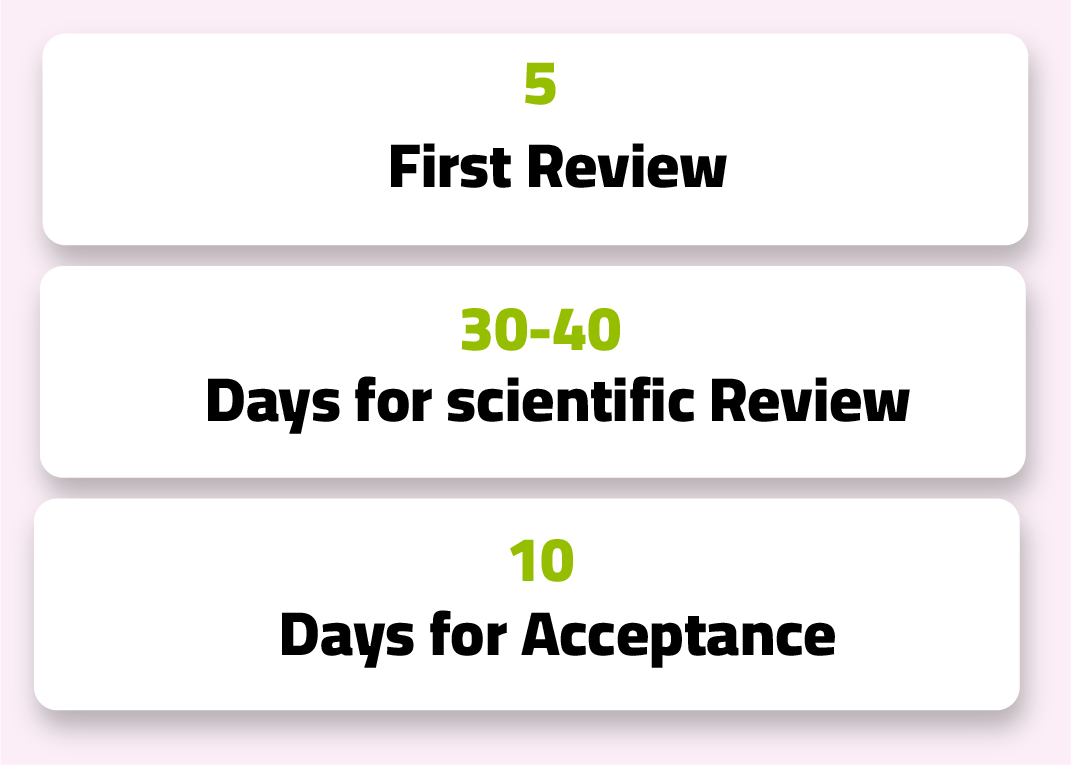
- Manuscripts that pass the initial screening are referred to qualified reviewers in accordance with the peer-review policy published on the journal’s website.
- Decisions to accept, request revision, or reject a manuscript are based on the reviewers’ reports, editorial evaluation, and the manuscript’s compliance with the journal’s standards.
- When revisions are requested, authors must submit a revised manuscript together with a detailed and organized response explaining how each reviewer comment was addressed or providing a scholarly justification when a particular revision was not made.
- Referral to peer review does not guarantee acceptance. Acceptance is not considered final until all required scientific, linguistic, editorial, and technical revisions have been completed.
- Accepted manuscripts undergo language and technical editing and final production before publication. The final proof is sent to the corresponding author for review within the specified period.
Eighth: Research Integrity and Disclosures
- Submitted manuscripts are screened for textual similarity using Turnitin or another similarity-detection system approved by the relevant official authorities.
- The journal does not base its assessment solely on the numerical similarity percentage. The Editorial Board evaluates the nature, source, extent, documentation, and effect of the identified similarity on the manuscript’s originality.
- Authors must avoid all forms of research and publication misconduct, including plagiarism, duplicate publication, undisclosed self-plagiarism, unjustified fragmentation of a study, fabrication, falsification or manipulation of data, image manipulation, and inappropriate authorship.
- Authors must disclose all actual or potential competing interests and all sources of financial or institutional funding and support.
- Ethical and official approvals must be obtained for studies involving participants, personal data, interviews, questionnaires, recordings, or institutional information.
- Participants’ privacy and data confidentiality must be protected, and informed consent must be obtained whenever required.
- Authors must disclose the use of generative artificial intelligence tools in preparing, editing, translating, analyzing data for, or generating any part of the manuscript. The name of the tool and the purpose for which it was used must be stated.
- Artificial intelligence tools may not be listed as authors or co-authors. Their use does not relieve the authors of full responsibility for the accuracy, originality, references, data, interpretations, and conclusions of the manuscript.
- Suspected misconduct shall be handled in accordance with the journal’s publication ethics and plagiarism policies published on its website.
Ninth: Copyright and Licensing
- Authors retain the copyright to their published work and grant the journal the right of first publication.
- Articles are published under the Creative Commons Attribution 4.0 International License (CC BY 4.0).
- This license permits copying, distributing, sharing, reusing, and adapting the work for commercial and noncommercial purposes, provided that appropriate credit is given to the authors, article title, journal title, publication source, and article link or DOI.
- Submission and acceptance of a manuscript constitute agreement with the journal’s published copyright and licensing policy.
Tenth: Publication Fees
- Publication fees, additional charges, and any available exemptions are stated on a separate page dedicated to the journal’s fee and waiver policy.
- Publication fees are charged only after a manuscript has been accepted. Fees and waiver requests do not influence editorial screening, peer review, acceptance, or rejection decisions.
- Authors are responsible for any additional charges resulting from exceeding the maximum permitted manuscript length, in accordance with the published policy.
Eleventh: Written Declaration
Authors must submit the journal’s approved written declaration confirming the following:
- The manuscript is original and has not previously been published in an identical or substantially overlapping form.
- The manuscript is not under simultaneous consideration by another journal or publishing body.
- All authors have approved the submitted version and the order in which their names appear.
- All author information and institutional affiliations are accurate.
- The manuscript is free from plagiarism, duplicate publication, data manipulation, and inaccurate or fabricated references.
- Funding, competing interests, ethical approvals, and the use of artificial intelligence have been disclosed whenever applicable.
- All authors agree to comply with the journal’s editorial and ethical policies and decisions concerning the manuscript.
Written Declaration