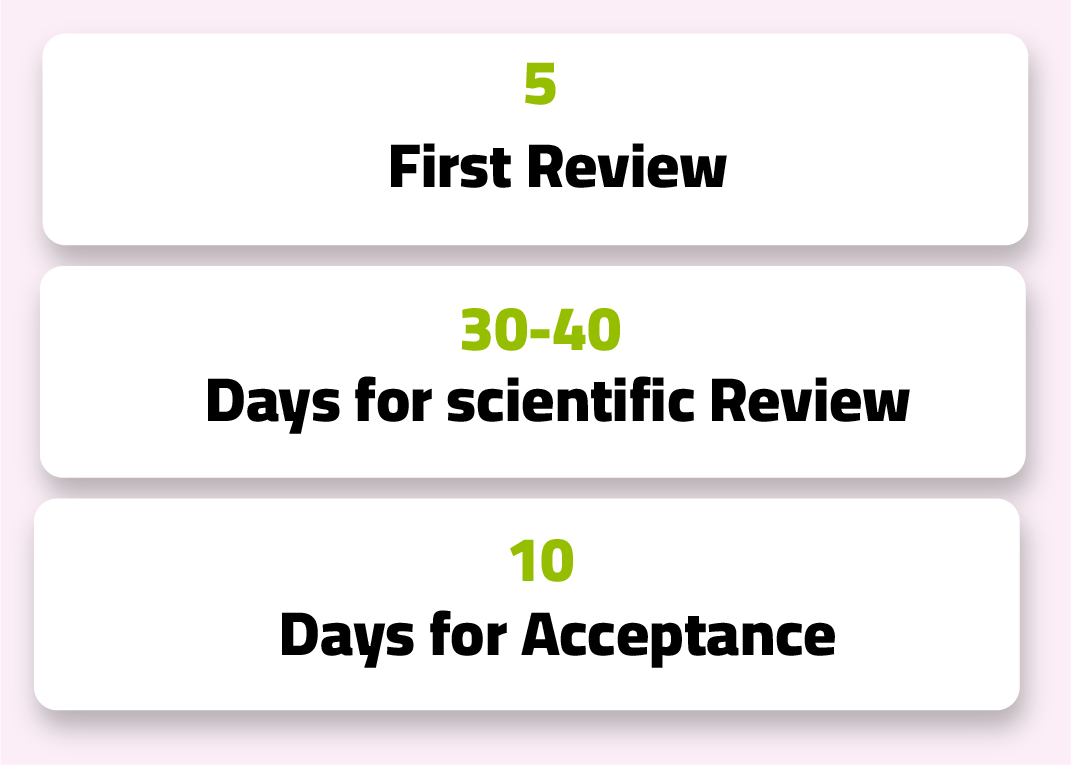
Manuscript Processing and Publication Workflow
Manuscripts submitted to Al-Fateh Journal for Educational and Psychological Research proceed through a series of editorial and peer-review stages, beginning with electronic submission and ending with publication, according to the following workflow:
1. Manuscript Submission
Manuscripts must be submitted electronically through the journal’s online system, together with all required documents, including the written declaration and any forms or statements required under the journal’s publication guidelines.
The Managing Editor verifies that the submission files and essential information are complete before the editorial evaluation begins.
2. Initial Editorial Screening
The Editorial Board conducts an initial screening of each manuscript to verify:
- Its conformity with the journal’s aims and scope.
- Its compliance with the author guidelines and journal template.
- The presence of an acceptable level of originality and scientific quality.
- The soundness of its methodology, organization, and language.
- The completeness of the required declarations and supporting documents.
A manuscript may be rejected at this stage if it falls outside the journal’s scope, fails to satisfy the submission requirements, or does not meet the minimum standards of scientific and methodological quality.
3. Textual Similarity Screening
Manuscripts that pass the initial screening are checked for textual similarity using Turnitin or another system approved by the relevant official authorities.
The Editorial Board evaluates the similarity report by considering the nature, sources, and extent of the identified similarities, the manner in which they are documented, and their effect on the manuscript’s originality. Editorial decisions are not based solely on the numerical similarity percentage.
When unjustified similarity is identified, the manuscript may be returned to the authors for revision or rejected, depending on the nature and seriousness of the case and in accordance with the journal’s plagiarism and textual-similarity policy.
4. Assignment to a Handling Editor
The manuscript is assigned to a member of the Editorial Board whose academic specialization is relevant to its subject. The handling editor oversees its evaluation and recommends suitable reviewers.
5. Selection of Reviewers
The Editorial Board selects reviewers with appropriate expertise and specialized knowledge of the manuscript’s subject, while considering their scholarly competence, independence, and freedom from conflicts of interest.
Review invitations are sent through the journal’s system, and invited reviewers are requested to accept or decline the assignment within the specified period.
6. Scientific Peer Review
The manuscript is sent to the reviewers who accept the assignment, together with the journal’s approved review form. Reviewers are asked to assess the manuscript in terms of:
- The originality and scientific significance of the subject.
- The clarity of the research problem and objectives.
- The appropriateness of the methodology and procedures.
- The accuracy of the analysis and presentation of results.
- The soundness of the discussion and conclusions.
- The adequacy and accuracy of the references.
- The quality of the language and scientific organization.
The journal seeks to receive review reports within 14 days of the reviewer’s acceptance of the assignment. This period may be extended when a reasonable justification is provided.
7. Evaluation of Review Reports
The Editorial Board examines the reviewers’ reports, compares their comments and recommendations, and reaches one of the following decisions:
- Accept without revision.
- Accept subject to minor revisions.
- Return for major revisions.
- Send for further review after revision.
Reviewers’ recommendations are not adopted automatically. The Editorial Board evaluates them in light of the manuscript’s scientific merit and the journal’s standards.
8. Manuscript Revision
When revisions are required, the reviewers’ and editors’ comments are sent to the corresponding author. The authors must submit:
- A revised version of the manuscript.
- A detailed response to all comments.
- A clear description of the revisions made.
- A scientific justification for any comment that has not been followed.
The revised manuscript must be submitted within the period specified by the journal. The manuscript file may be closed when the authors fail to respond without requesting a justified extension.
9. Review of the Revised Manuscript
The Editorial Board reviews the revised manuscript to verify that the requested changes have been adequately addressed. When revisions are substantial or require further specialist assessment, the manuscript may be returned to the original reviewers or referred to other reviewers.
The revision and review stages may be repeated until the manuscript satisfies the journal’s scientific requirements or is rejected for failure to address essential concerns.
10. Final Editorial Decision
The Editor-in-Chief makes the final decision regarding the manuscript based on:
- The results of the editorial screening.
- The reviewers’ reports.
- The authors’ responses to the requested revisions.
- The manuscript’s compliance with the journal’s guidelines and policies.
- The scientific and ethical integrity of the final version.
The corresponding author is formally notified of the decision through the journal’s online system or official email address. A manuscript is not considered accepted for publication until a final acceptance decision has been issued.
11. Language Editing and Technical Preparation
Following final acceptance, the manuscript undergoes language editing and technical preparation to verify:
- Linguistic accuracy and clarity of expression.
- Consistency of headings and terminology.
- Compliance of tables and figures with the journal template.
- Accuracy of author information and references.
- Completeness of publication metadata and the digital object identifier.
The manuscript may be returned to the authors for specific corrections before it is prepared for publication.
12. Final Proof Review
The final proof is sent to the corresponding author to verify the accuracy of the authors’ names and institutional affiliations, bibliographic information, and the text prepared for publication.
At this stage, revisions are limited to correcting minor typographical, linguistic, and technical errors. No substantial changes may be made to the manuscript’s subject, methodology, data, or findings after acceptance without prior approval from the Editorial Board.
13. Publication
The accepted manuscript is assigned to an issue determined by the Editorial Board according to the date on which the acceptance procedures were completed, the journal’s publication schedule, and the available capacity of each issue.
The article is published electronically on the journal’s official website and assigned a Digital Object Identifier (DOI). The published version becomes the official version of record for scholarly citation.
The journal seeks to complete the screening, peer-review, and decision-making process within a period not exceeding three months. Delays caused by the authors or by circumstances beyond the journal’s control are not included in this period.